
You have shortlisted a disinfection provider, reviewed their brochure and liked the price. But the contract sitting in your inbox is three pages of vague scope, a single frequency line and no mention of who is actually turning up to do the work. That is the moment most facility managers either sign anyway or start renegotiating from a weak position.
A disinfection contract is not just a price agreement. It is the document that defines what gets cleaned, how it gets cleaned, who is accountable when something is missed, and what happens if an outbreak forces an emergency call-out. Get those details wrong and you are paying for a service that looks compliant on paper but leaves gaps on the ground.
This guide is written for facility managers, office managers, and building operators in Singapore who are evaluating or renewing a commercial disinfection agreement. The questions are practical and the red flags are real.
Why this matters: A vague disinfection contract can leave your building exposed when it matters most, whether during an outbreak, a regulatory inspection, or a routine audit.
Highlights
- Scope of work should name every area and surface category covered, not just "common areas" or "high-touch surfaces" without a room list.
- Method and chemistry matter: a contract that does not specify the disinfectant, its kill claims and its dwell time gives you no way to verify the job was done right.
- In-house technicians accredited by RIA, IAQA and IICRC are a meaningful differentiator from providers who sub-contract without disclosure.
- Emergency and same-day response terms should be written into the agreement, not left as a verbal promise.
- BioProtect antimicrobial coating, EPA-registered and NSF-D2, can extend surface protection for up to 90 days between scheduled visits.
What the scope of work section should actually say
The most common failure in disinfection contracts is a scope section that sounds comprehensive but commits to nothing. Phrases like "all common areas" and "high-touch surfaces throughout the premises" are nearly meaningless without a room-by-room schedule attached.
The room and surface schedule
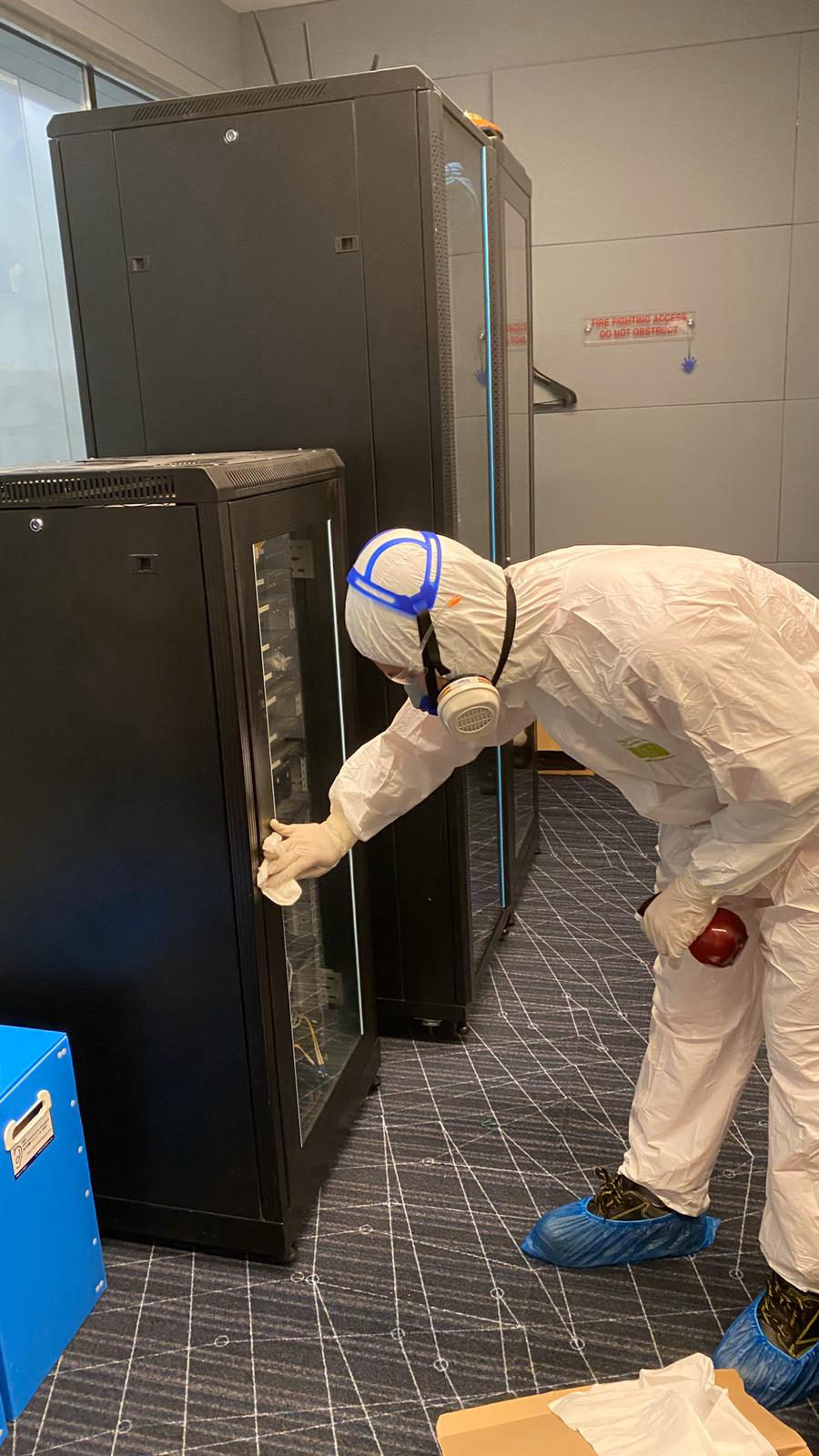
A properly written scope names the spaces: reception, open-plan workstations, meeting rooms, pantry and staff kitchen, server room access points, lift lobbies, washrooms and the number of cubicles, loading bays. It then lists the surface categories within each space:
- Desk surfaces, keyboards and monitors
- Door handles, push plates and light switches
- Lift buttons and handrails
- Pantry countertops, taps and appliance handles
- Washroom fixtures and dispensers
If the contract uses a catch-all phrase instead of this level of detail, ask for the schedule as an attachment before signing. A provider who cannot produce one has not scoped the job.
Frequency and rotation
Frequency should match the building's use pattern, not a default package. A busy F&B operation with high footfall needs a different cadence than a small professional office. The contract should state the visit frequency, the day and time windows, and whether certain areas (washrooms, pantry) are treated at a higher frequency than the main floor.
The method and chemistry clause
What the technician sprays matters as much as how often they arrive. A contract that simply says "disinfection using approved chemicals" tells you nothing about efficacy.
What the contract should specify
Look for these four items in writing:
- The disinfectant product name and its kill claims: a hospital-grade disinfectant that kills 99.999% of bacteria, including E. coli and Salmonella, in under 60 seconds is a specific, verifiable claim. "Approved disinfectant" is not.
- Dwell time: the period the product must stay wet on a surface to achieve its rated kill. If a technician wipes a surface dry immediately, the chemistry has not had time to work.
- Application method: fogging, electrostatic spraying, wipe-down or a combination. Each suits different surfaces and spaces.
- Safety profile: particularly for food-contact surfaces, occupied spaces and areas where children or patients are present. Big Red's hospital-grade disinfectant is Made in USA with zero triclosan, heavy metals, arsenic or phenols.
If a provider cannot tell you the dwell time for their product, that is a warning sign. Proper virus disinfection and decontamination is a technical process, not a cleaning round.
The BioProtect coating option
Some contracts include an antimicrobial coating applied after the initial disinfection. BioProtect, the BIOPROTECTUs System, is an EPA-registered, NSF-D2 quaternary organo-silane coating that bonds to porous and non-porous surfaces and keeps self-disinfecting for up to 90 days. It is worth asking whether your provider offers this and, if so, whether it is priced into the contract or charged separately.
Who is actually doing the work
This is the clause most facility managers never think to check until something goes wrong.
In-house versus sub-contracted technicians
Many disinfection providers quote the job and sub-contract the labour. That means the technician arriving at your building may work for a third party with different training, different equipment and a different set of accountability standards. The original provider often has no direct control over quality.
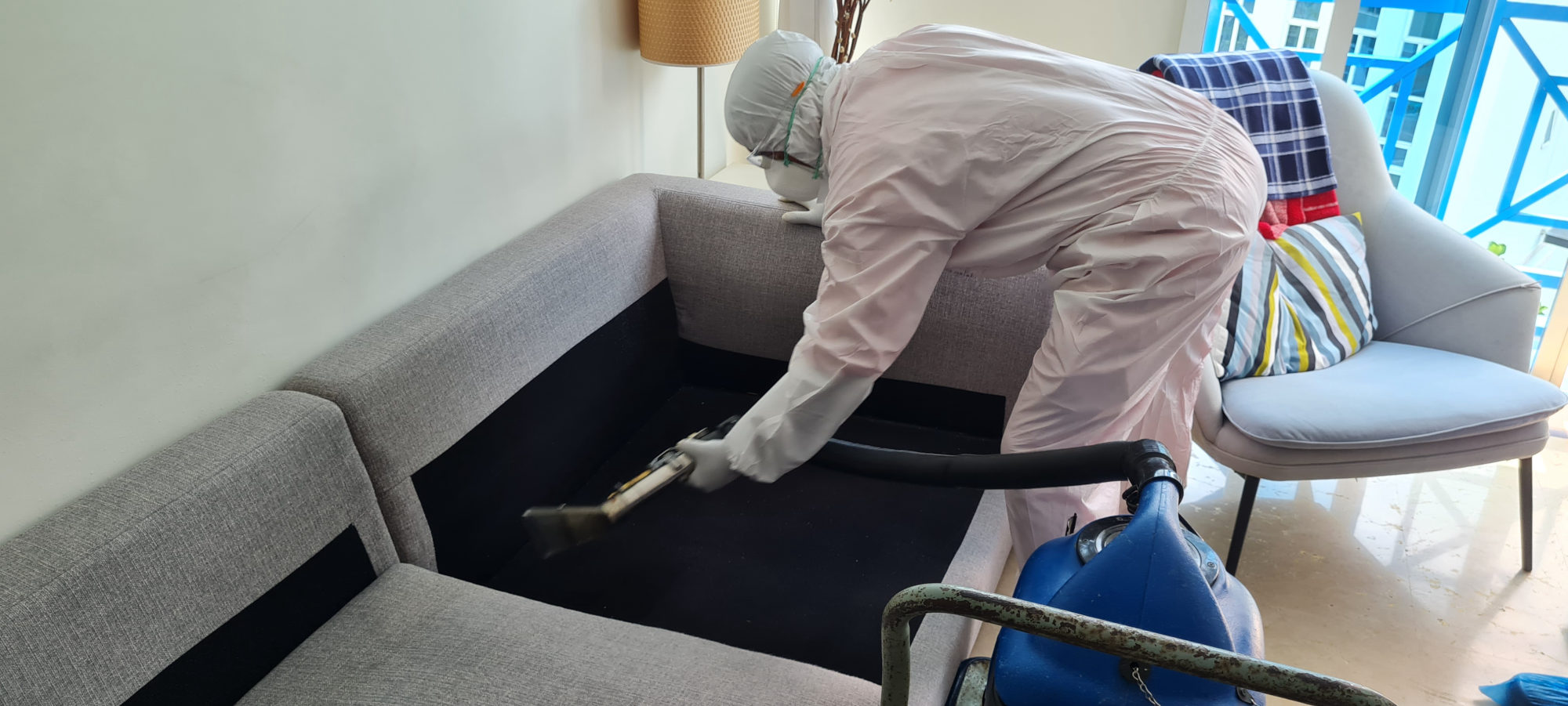
The alternative is an in-house technician model, where the company employs, trains and accredits its own staff. Big Red's technicians are in-house and hold accreditation from the RIA (Restoration Industry Association), IAQA (Indoor Air Quality Association) and IICRC (Institute of Inspection, Cleaning and Restoration Certification). The contract should state explicitly whether work is performed by employees or sub-contractors, and if the latter, what oversight is applied.
This matters especially for decontamination work in sensitive environments such as clinics, laboratories and food production areas, where the technician's training is as important as the product they use.
Supervision and sign-off
Each visit should produce a service record: the technician's name, the areas treated, the products used, the dwell time observed, and a sign-off from both parties. Some contracts include a digital log; others use a paper form. Either works, but the absence of any record-keeping is a red flag. In the event of a complaint or an audit, this documentation is your evidence that the service was delivered as agreed.
Emergency response and escalation terms
A routine disinfection schedule covers normal operations. But what happens when a confirmed COVID-19 case, a norovirus outbreak, or a pest incident forces an unscheduled call-out?
What to ask before you sign
- Is same-day emergency response available, and is it written into the contract or subject to availability?
- What is the guaranteed response time for an emergency call-out?
- Is emergency response included in the contract price, or charged at a premium rate?
- Who is the escalation contact, and what are their hours?
Big Red offers same-day and 24/7 emergency response for situations that cannot wait. That commitment should appear in writing in any contract we provide, not as a verbal assurance from the sales team.
For facility managers who also carry responsibility for indoor air quality (IAQ) testing after an incident, it is worth confirming whether the disinfection provider can also perform post-event air quality verification, or whether you will need a separate specialist.
What to watch out for: the common gaps
After reviewing many commercial disinfection agreements, these are the gaps that appear most often:
|
Gap |
Why it matters |
What to ask for instead |
|---|---|---|
|
Vague scope ("common areas") |
No way to verify coverage |
A named room-and-surface schedule |
|
No dwell time specified |
Kill claims may not be met |
Dwell time stated per product |
|
Sub-contracting not disclosed |
Unknown training and accountability |
Written statement on in-house vs sub-contract |
|
No emergency response terms |
Verbal promises are unenforceable |
Response time and cost in writing |
|
No service records or sign-off |
No evidence the job was done |
A per-visit service record requirement |
|
Renewal auto-clause with price escalation |
Unexpected cost increases |
A capped escalation or fixed rate for the term |
A contract that addresses all six of these is not unusual. It is what a professionally run disinfection agreement looks like. If a provider pushes back on any of them, that tells you something about how they operate.
Frequently asked questions
How often should a commercial building in Singapore be professionally disinfected?
It depends on occupancy, footfall and the nature of the business. A busy F&B outlet or clinic with high daily footfall warrants more frequent visits than a small professional office. Most commercial contracts run on a weekly or fortnightly cycle for routine disinfection, with additional treatments after any confirmed illness case or high-risk event.
Does a disinfection contract cover mold or odor problems as well?
Not usually. Standard disinfection contracts cover bacteria and virus control on surfaces. Mold remediation and foul odor treatment are separate specialist services that require different equipment, different chemistry and different training. If your building has both needs, confirm with your provider whether those services are in scope or need to be contracted separately.
What certification should I look for in a disinfection provider?
Look for accreditation from the RIA (Restoration Industry Association), IAQA (Indoor Air Quality Association) or IICRC (Institute of Inspection, Cleaning and Restoration Certification). These are internationally recognised bodies with training and standards specific to disinfection, remediation and indoor air quality. bizSafe3 certification is also relevant for Singapore workplace safety compliance.
Is it safe to disinfect an occupied office?
Yes, with the right product and method. Big Red's hospital-grade disinfectant contains zero triclosan, heavy metals, arsenic or phenols, and is safe for occupied spaces once the dwell time has elapsed and surfaces are dry. For fogging treatments, a short evacuation period may be advisable depending on the space and the product concentration. The contract should specify any access requirements clearly.
What happens if a treated area tests positive after a scheduled visit?
A well-written contract addresses this. It should specify the provider's obligation to return for a remedial treatment at no additional charge if the service was performed within the agreed scope and the positive result relates to a covered surface or area. Ask for a re-treatment clause before signing.