
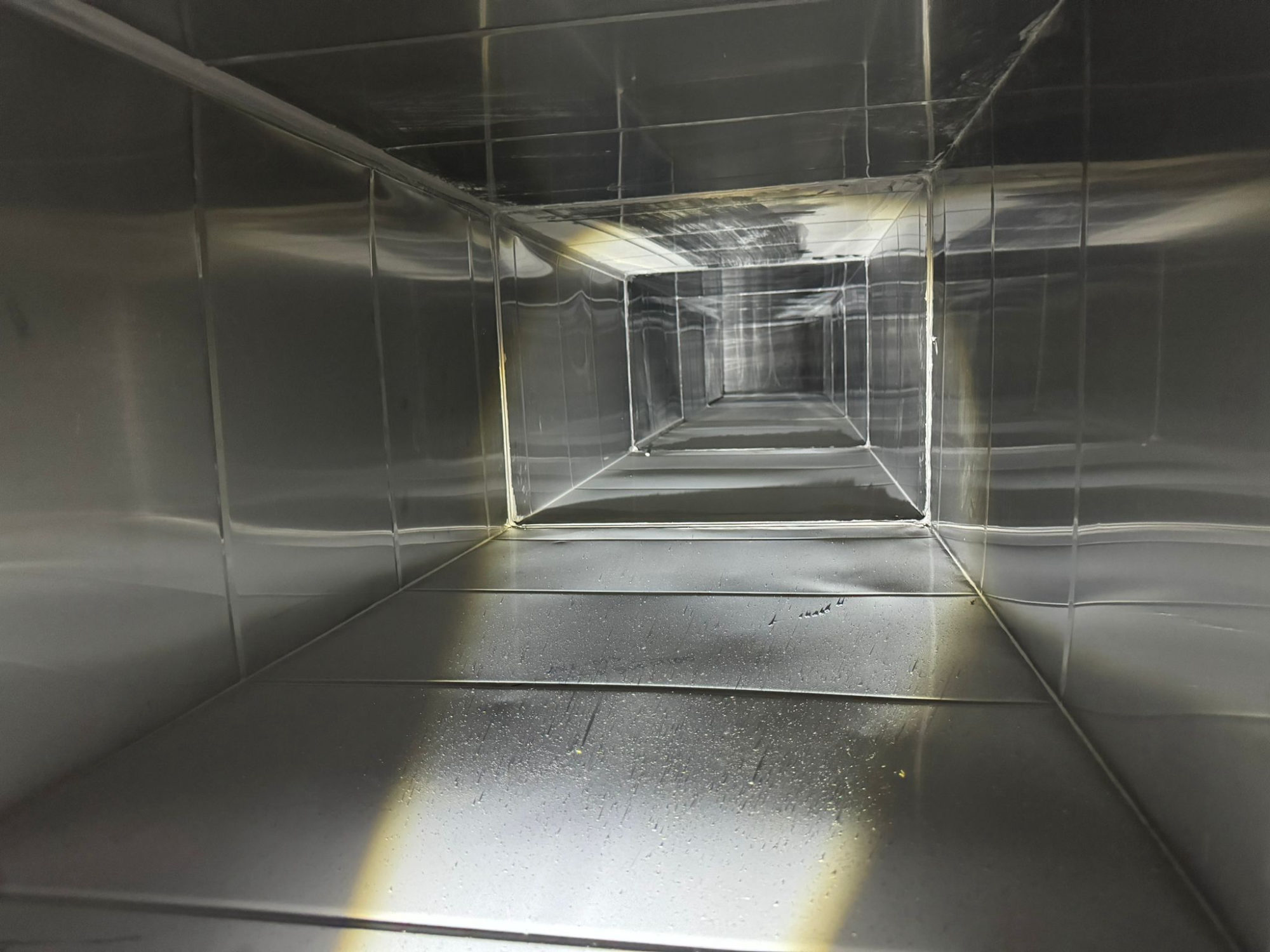
Duct cleaning is one of those maintenance line items that gets pushed to the next quarter, then the one after that, until someone starts complaining about the air. By that point the problem is usually visible: grey-brown dust rings around supply grilles, a persistent musty smell from the vents, or an IAQ complaint from a tenant that ends up on the building manager's desk.
For commercial buildings in Singapore, the stakes are higher than in a home. The HVAC system runs longer hours, serves more people, and moves far more air through a far more complex network of ducts. What accumulates in those ducts over 12 or 24 months is not just dust. It includes biological matter, mold spores, fine particulates from renovation work or kitchen exhaust, and in some cases vermin debris. A residential split unit and a commercial central air-conditioning system are a different category of problem.
This article is for facility managers, building managers and operations teams who want to understand what a professional air duct and HVAC cleaning service actually covers, how frequently different building types need it, and what the real cost of deferring it looks like.
Why this matters: The air your tenants, staff or guests breathe passes through every metre of your ductwork, so what lives inside those ducts becomes part of the indoor environment you are responsible for.
Highlights
- Accumulated dust, mold spores and biological matter inside commercial ducts recirculate through occupied spaces with every cooling cycle.
- A professional duct cleaning scope covers supply, return and exhaust ducts, AHUs, fan coil units, drain pans and diffusers, not just the grilles.
- Recommended cleaning frequency varies by building type: 1–2 years for offices, annually for hotels and F&B, and every 6–12 months for healthcare facilities.
- Big Red's in-house technicians are accredited by the RIA, IAQA, IICRC and bizSafe3, and we never sub-contract the work.
- An indoor air quality (IAQ) test before and after cleaning gives you a measurable baseline and a record for tenants or regulators.
What a commercial HVAC duct cleaning actually covers
The grilles are the part everyone can see, so they often get wiped down during a routine cleaning round and the work stops there. A professional air duct cleaning service goes significantly further.
The full scope of work
For a commercial central system, the scope typically includes:
- Supply and return air ducts, from the air handling unit (AHU) to each diffuser or grille, cleared of accumulated dust, debris and biological deposits.
- Air handling units, including coil surfaces, drain pans and internal surfaces where standing water and organic material accumulate.
- Fan coil units (FCUs), the terminal units in individual rooms or zones.
- Exhaust and transfer ducts, which in F&B and healthcare buildings carry grease-laden or contaminated air and need specialist attention.
- Diffusers, grilles and registers, removed, cleaned and replaced rather than wiped in place.
- Drain pan inspection and treatment, because a partially blocked or bio-filmed drain pan is one of the most common sources of mold inside a commercial HVAC system.
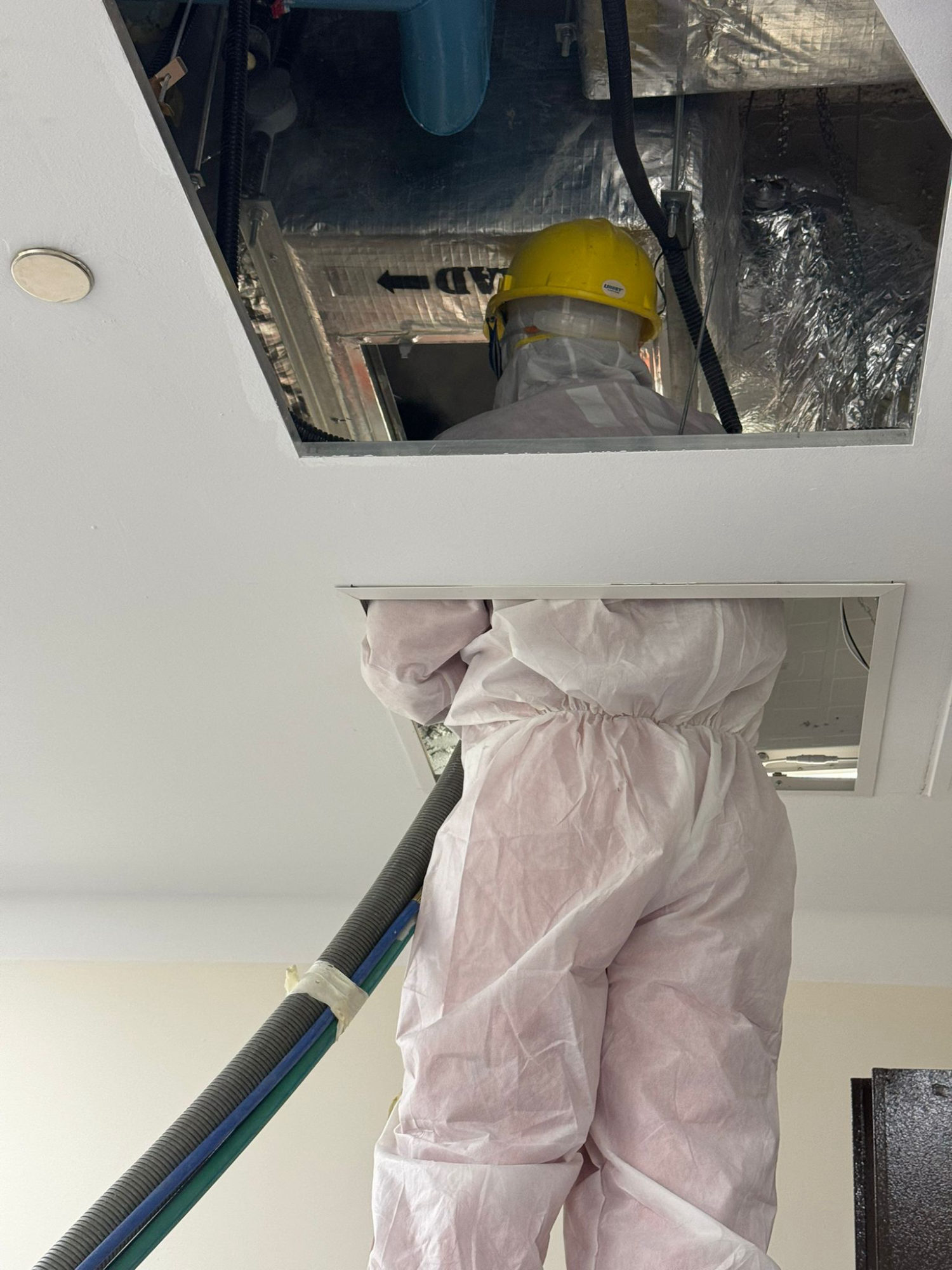
The equipment used for commercial work is heavier-duty than what a residential job requires: truck-mounted or large portable negative-pressure machines, robotic camera inspection for long or inaccessible duct runs, and HEPA-filtered extraction so dislodged material does not recirculate into the occupied space during the clean.
Why inspection comes first
Before any cleaning begins, a camera inspection of the ductwork gives a baseline record of what is inside and where the worst accumulation is. This matters for two reasons. First, it tells the crew where to concentrate effort. Second, it gives the building manager documented evidence of pre-clean conditions, which is useful if a tenant or insurer asks questions later.
After cleaning, a post-clean camera pass confirms the result. The ISSA notes that HVAC systems are central to indoor air quality in commercial buildings, and that dirty or poorly maintained systems undermine air quality regardless of what other IAQ measures are in place. A documented clean is the clearest way to demonstrate the system has been properly maintained.
How often commercial buildings need duct cleaning
There is no single answer, but there are clear patterns based on building type, occupancy and what the system handles. Deferring beyond these intervals is where most IAQ complaints and energy-efficiency problems start.
|
Building type |
Recommended interval |
Key reason |
|---|---|---|
|
Office (low renovation, stable occupancy) |
Every 2 years |
Dust and particulate accumulation from sustained occupancy |
|
Office (post-renovation or high churn) |
Every 12–18 months |
Construction dust and changed occupancy loads |
|
Hotel (guest rooms and public areas) |
Annually |
High occupancy hours, guest expectations, humid ambient conditions |
|
F&B (kitchen and front-of-house) |
Every 6–12 months |
Grease accumulation in kitchen exhaust is a fire and contamination risk |
|
Healthcare (clinics, day surgeries, hospitals) |
Every 6–12 months |
Regulatory expectation, infection control, vulnerability of occupants |
|
Mixed-use commercial |
Annually as a baseline |
Varies by tenant mix; re-assess after any major fit-out or incident |
Singapore's year-round humidity accelerates biological growth inside ductwork compared with drier climates. A system that sits at the two-year mark in a temperate country may genuinely need attention at 12 months here, particularly if the building has experienced any water ingress, a drain pan overflow or an AHU condensate issue.
When to bring the interval forward
Scheduled intervals aside, there are situations where an assessment and clean should not wait:
- Visible mold growth at grilles or on AHU surfaces.
- A persistent musty or stale smell from the vents that does not clear after filter replacement.
- IAQ complaints from tenants or staff: elevated dust, dryness, or an air quality reading that does not match what the system should be delivering.
- After a major renovation or fit-out that generated significant dust inside the building.
- After any flood, water leak or drain pan overflow that may have introduced moisture into the ductwork.
- Before a building changes tenants or undergoes a change of use.
Research published by PMC examining HVAC systems and airborne pathogen transmission found that dirty ductwork and poorly maintained ventilation systems can facilitate the spread of contaminants through occupied spaces. That finding reinforced what facility managers in healthcare and hospitality already knew from experience: a neglected system does not just underperform, it actively works against the indoor environment.
What deferred cleaning actually costs
The cost of not cleaning is less visible than a service invoice but it shows up in three places.
Energy efficiency. A duct system with significant dust and debris accumulation forces the AHU fans to work harder to push the same volume of air. That means higher electricity consumption for the same cooling output. In a commercial building running 10 to 14 hours a day, the compounding effect is measurable over a year.
IAQ and tenant relations. Elevated dust levels and mold spore counts in the circulated air are a direct result of what is inside the ductwork. An IAQ test can measure particulate matter, VOCs, formaldehyde and spore counts in the occupied space, and the readings often correlate directly with duct condition. Once a tenant has filed a complaint or a client has raised a building quality concern, the conversation is harder than a scheduled maintenance visit would have been.
Reactive versus planned cost. Emergency duct work, post-complaint inspections and urgent remediations cost more than planned maintenance, both financially and in management time. A mold inspection triggered by a tenant complaint is more disruptive and more expensive than catching the same growth in a scheduled HVAC service.
For context, a post-renovation duct condition is one of the most common triggers for accelerated problems. If you have recently completed a fit-out and want to understand what settled into the system, the article on air duct cleaning after a renovation covers what construction dust does inside a duct run and why it matters before you fully occupy the space.
What to look for in a commercial duct cleaning provider
Not all providers approach commercial work the same way. When you are evaluating a vendor for a procurement decision, a few things separate a genuinely capable team from one that cleans grilles and calls it done.
In-house technicians, not sub-contractors. When a company sub-contracts the work, your point of contact and the person doing the job are different people, with different accountability. Big Red's technicians are employed in-house, trained to our standard, and directly accountable for the work.
Relevant accreditations. The RIA (Restoration Industry Association), IAQA (Indoor Air Quality Association) and IICRC (Institute of Inspection, Cleaning and Restoration Certification) are the benchmarks for this category of work. They indicate the team has been trained to a defined standard, not just given equipment and sent out. Our technicians hold accreditation across all three, alongside bizSafe3.
A documented scope and a post-clean record. A professional job starts with a written scope, includes pre- and post-clean inspection, and leaves you with a record. That record matters for building audits, tenant queries and your own maintenance log.
IAQ testing capability. Pairing the duct clean with an IAQ assessment before and after gives you data, not just a cleaned-looking grille. If a building manager needs to demonstrate to a tenant or a regulator that the indoor environment meets a standard, a test result is what makes that case. Related: see why Google, DBS Bank, JW Marriott and Resorts World Sentosa trust Big Red with their indoor environments.
Frequently asked questions
How often should commercial HVAC ducts be cleaned in a Singapore office?
For a standard office with stable occupancy and no recent renovation, every two years is a reasonable baseline. Bring that forward to 12–18 months after a fit-out, if IAQ complaints arise, or if the building runs very long cooling hours. Singapore's humidity accelerates biological growth inside ductwork compared with cooler climates, so local intervals tend to be shorter than international guidelines suggest.
What does a commercial air duct cleaning service in Singapore actually include?
A professional scope covers supply and return duct runs, AHUs, fan coil units, drain pans, exhaust ducts and all diffusers and grilles. For F&B premises it includes kitchen exhaust ductwork, which carries grease and needs more frequent attention. Pre- and post-clean camera inspection and a written record of condition are part of what separates a thorough job from a surface clean.
Can duct cleaning be done while the building is occupied?
Yes, in most cases. We use negative-pressure extraction so that dislodged material is captured rather than recirculated into the occupied space. For healthcare facilities and certain sensitive environments, we schedule work out of hours or in sections. The specific plan depends on the building layout and the occupancy pattern.
How does dirty ductwork affect IAQ readings?
Accumulated dust, mold spores and biological matter in the ductwork re-enter the circulated air with every cooling cycle. An IAQ test will often show elevated particulate matter or spore counts in a space served by a dirty system. After a thorough duct clean, a follow-up test typically shows a measurable improvement in those readings, giving building managers a documented baseline for future reference.
Do we need an IAQ test alongside the duct clean?
It is not mandatory, but it is worth doing, particularly for buildings where tenants or staff have raised air quality concerns. An IAQ assessment before cleaning establishes what the air actually contains: particulate matter, VOCs, formaldehyde and mold spore counts. The post-clean test shows what changed. That before-and-after record is useful for tenant communications, building audits and your own maintenance documentation.