
A vendor tells you their antimicrobial coating protects surfaces for 90 days and you think: that sounds too good to be true for a clinic corridor that gets wiped down twice a day. It's a fair reaction. Most surface coatings wash off the first time a cleaner hits them with a disinfectant spray and a microfiber cloth.
BioProtect works differently, and that difference is worth understanding before you compare quotes or sign a maintenance contract. The chemistry is the reason the protection lasts, and knowing it helps you ask the right questions of any vendor.
This is not a pitch. If your surfaces don't meet the conditions for the coating to bond, or if your cleaning frequency is extreme, we'll tell you that too.
Why this matters: Facility managers in Singapore's clinics, hotels and F&B outlets need antimicrobial surface protection that survives real-world cleaning schedules and the country's humid climate, not just a laboratory claim on a brochure.
Highlights
- BioProtect (the BIOPROTECTUs™ System) is EPA-registered and NSF-D2 certified, meaning it is independently verified safe for food-contact surfaces.
- The coating bonds at the molecular level to both porous and non-porous surfaces, fabric, glass, metal, plastic, timber, and keeps self-disinfecting for up to 90 days.
- It kills 99.999% of bacteria on treated surfaces and does not wash off with routine cleaning the way a spray disinfectant does.
- Made in the USA with zero triclosan, heavy metals, arsenic or phenols, safe for occupied spaces including food-preparation areas and patient rooms.
- In-house RIA-, IAQA-, IICRC-, bizSafe3- and CRI-accredited technicians apply it; no sub-contracting.
- Same-day and 24/7 emergency response available for urgent applications.
How the coating actually bonds, and why it survives cleaning
Most disinfectants kill bacteria on contact and then evaporate. They leave no residual protection, which is why you need to reapply them daily or after each wipe-down. A coating that claims to last 90 days has to do something structurally different.
BioProtect uses a quaternary organo-silane compound. When applied to a surface, it forms a covalent bond with the substrate, it is not sitting on top like a film, it is chemically anchored. The active layer then works mechanically: it punctures microbial cell membranes on contact rather than releasing a chemical into the environment. Because no chemical is consumed in the killing process, the coating stays active across repeated cleaning cycles.
What surfaces it bonds to
The bonding works across a wide range of materials that facilities managers deal with daily:
- Non-porous surfaces: glass, stainless steel, polished granite, laminate, hard plastic, powder-coated metal
- Porous surfaces: fabric upholstery, carpet, timber, concrete, plasterboard, acoustic panels
- Mixed surfaces: elevator interiors, reception counters, door handles and push plates, handrails, nurse call buttons, keyboard covers
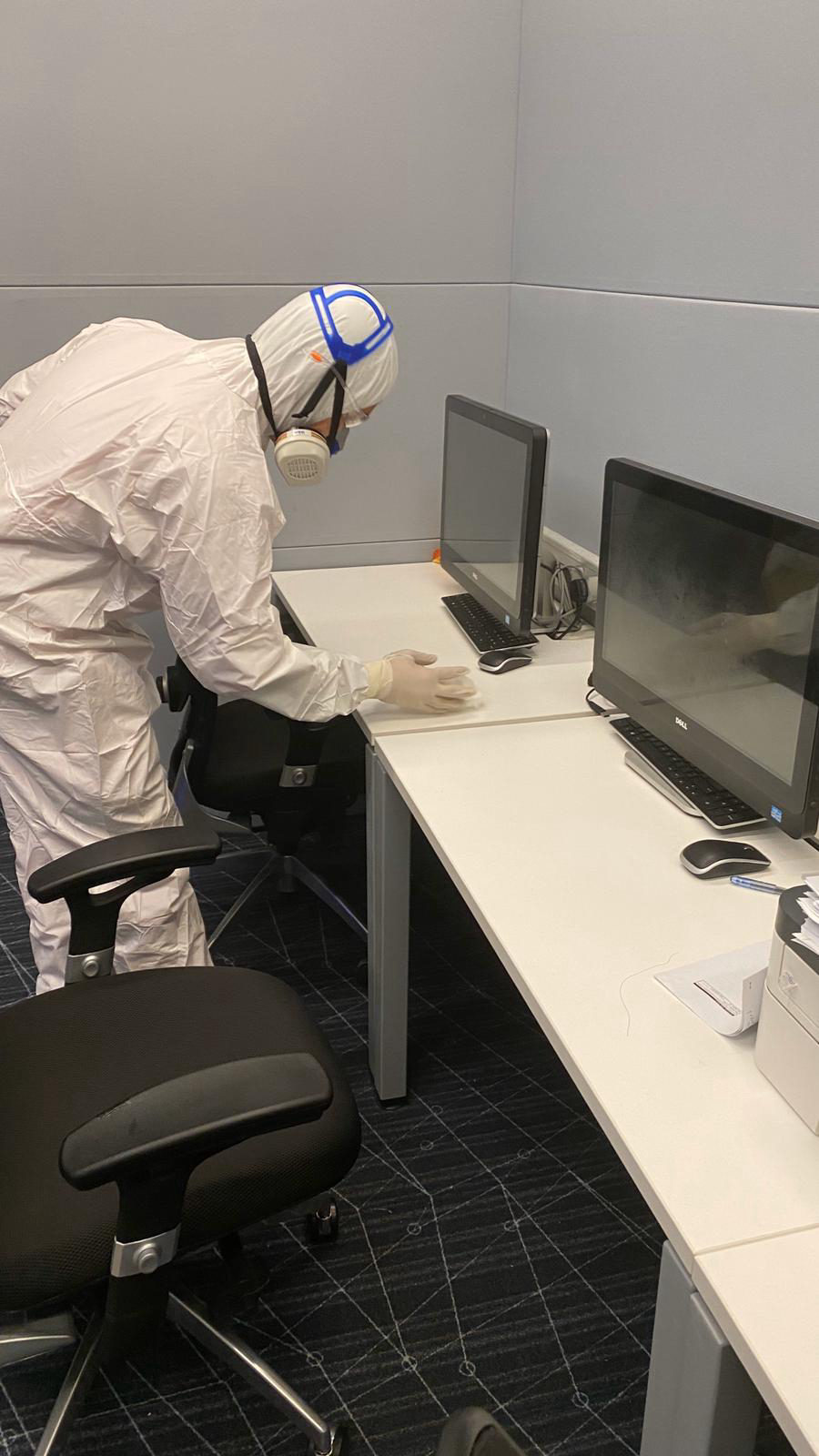
The condition is surface preparation. Grease, existing biofilm or heavy contamination prevents the bond. That is why we pair every BioProtect application with a thorough virus disinfection and decontamination pass first: the coating goes onto a clean, properly treated surface, and it bonds the way it is supposed to.
Does Singapore's humidity affect the bond?
Humidity does not break the covalent bond once it has formed. The application itself needs to happen on a dry surface, which in Singapore's climate means proper site preparation. High-humidity environments are actually where a persistent antimicrobial surface coating earns its place, because bacteria and mold spores thrive in them and routine wipe-downs cannot keep pace with recontamination.
For spaces with persistent dampness, a clinic sterilisation room, a hotel basement corridor, an F&B kitchen, we sometimes recommend an indoor air quality (IAQ) test before application, to understand the contamination baseline in both the air and on surfaces.
The 90-day claim: what the evidence supports and where the limits are
The 90-day figure is not marketing copy. BioProtect's EPA registration requires the protection claim to be supported by independent testing. The coating is also NSF-D2 certified, which means it has been independently verified as safe for incidental food contact, a standard that matters in F&B and hospital kitchens and that rules out a lot of cheaper coatings that carry no such certification.
That said, "up to 90 days" is honest language. Here is what affects the active life in practice:
|
Factor |
Effect on protection period |
|---|---|
|
Surface preparation before application |
Poor prep = weak bond = shorter life |
|
Cleaning chemical aggressiveness |
Abrasive or very high-pH cleaners degrade faster |
|
Cleaning frequency |
Very high frequency (6+ cleans per day) shortens active life |
|
Physical abrasion |
High-traffic floor surfaces wear faster than walls or ceilings |
|
Surface type |
Non-porous bonds are typically more durable than porous |
For a typical Singapore office or hotel room cleaned once or twice daily with standard neutral detergents, the 90-day window is realistic. For a clinical-grade sterilisation protocol using aggressive chemicals multiple times a day, the realistic window is shorter and we will say so upfront rather than oversell it.
Comparing antimicrobial surface options
Facility managers in Singapore typically weigh three approaches:
|
Approach |
Protection duration |
Kill claim |
Food-contact safe |
Independent certification |
|---|---|---|---|---|
|
Daily disinfectant spray |
Until next wipe |
Varies by product |
Sometimes |
Varies |
|
Quaternary ammonium wipes |
Hours |
Moderate |
Sometimes |
Varies |
|
BioProtect antimicrobial coating |
Up to 90 days |
99.999% bacteria |
Yes (NSF-D2) |
EPA-registered |
The coating does not replace your daily cleaning schedule. It supplements it, providing a kill layer between cleans that catches what the mop or cloth misses.
Where antimicrobial surface coating matters most in Singapore
Not every space needs a 90-day antimicrobial coating. The honest answer is that it is most worth it where high-touch surfaces carry genuine contamination risk and where reapplication of daily disinfectant is impractical or insufficient.
Clinics and healthcare facilities
Patient chairs, treatment beds, door handles, medication trolleys, nurse call buttons and shared equipment are high-frequency touch points. Related: see why Google, DBS Bank and JW Marriott trust Big Red with their indoor environments, along with healthcare and clinical operators across Singapore. For facilities with a history of water damage or mold, BioProtect adds protection against mold on treated surfaces as part of a broader remediation plan.
Hotels and serviced apartments
Elevator interiors, lobby seating, in-room remote controls, light switches and bathroom surfaces all accumulate bacteria between cleans. A coating that stays active for up to 90 days between guest turnovers addresses recontamination more reliably than a spray-and-wipe between each stay.
F&B and food-preparation environments
NSF-D2 certification is the deciding factor here. Many antimicrobial products cannot be used near food-preparation surfaces. BioProtect can, which is why it is applied in commercial kitchens and cafeteria counters where routine disinfection alone is not enough.
Offices and co-working spaces
Keyboards, shared phones, printer touch panels, kitchenette surfaces and elevator buttons are the vectors that matter in dense office environments. For facilities dealing with a recurring contamination concern, a decontamination service for a Singapore office followed by BioProtect application addresses both the immediate and the ongoing risk.
When professional application makes sense, and when it doesn't
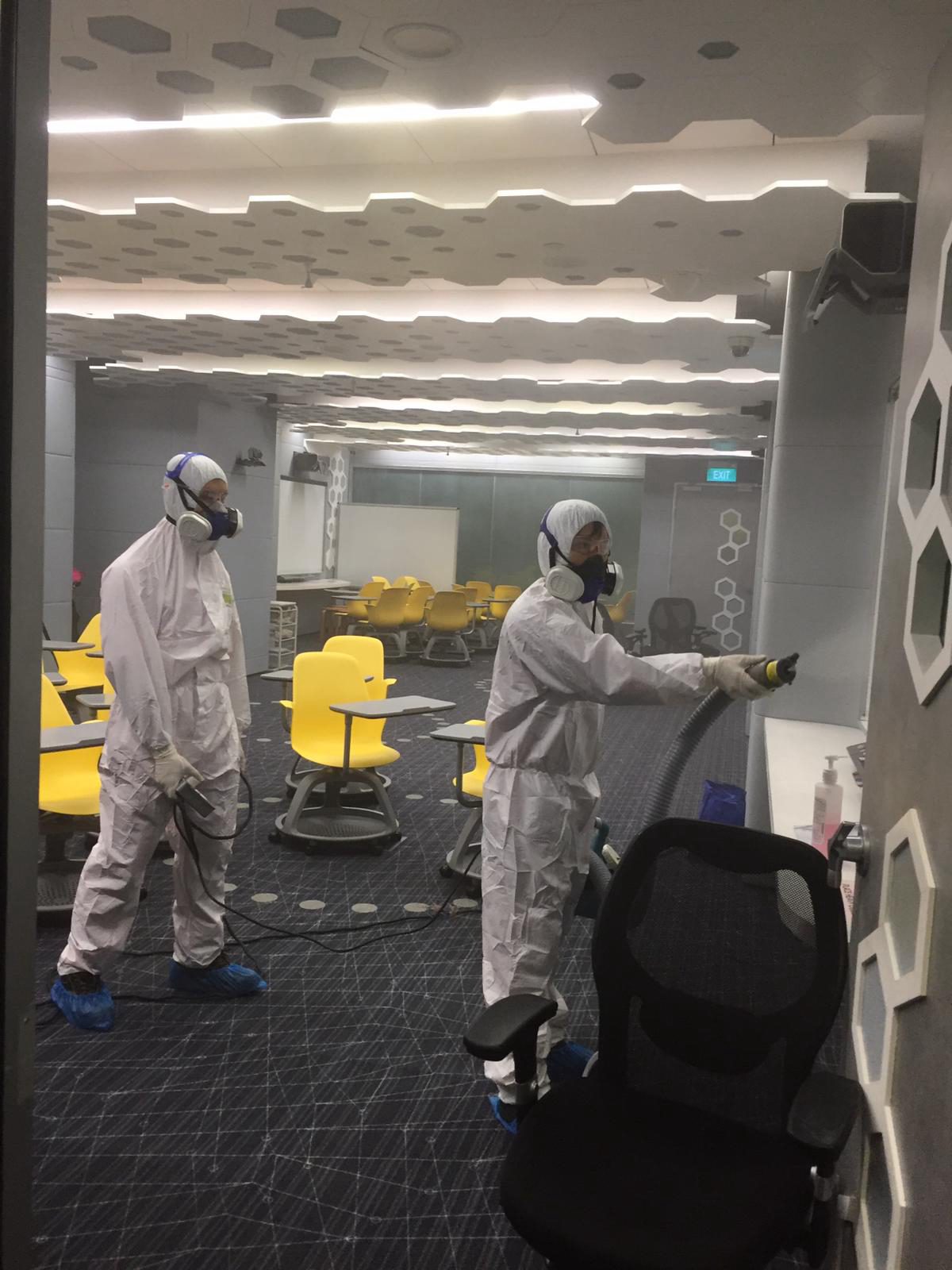
You can buy antimicrobial spray products off the shelf. Some are genuinely useful for home use on a small area. But the bonding chemistry of a quaternary organo-silane coating requires correct surface preparation, proper dwell time for the initial disinfection pass, and even application across all high-touch points, which is harder than it sounds across a 2,000 sqm clinic floor or a 15-storey hotel.
DIY application on a single bathroom vanity? Possibly fine. A commercial facility where the protection claim has to hold up under audit, where NSF-D2 certification matters, and where uneven application creates gaps in coverage? That is where in-house accredited technicians earn their place. Our team is accredited by the RIA, IAQA, IICRC, bizSafe3 and CRI, and we never sub-contract the application.
For facilities already thinking about commercial disinfection contracts in Singapore, a BioProtect application is often structured as part of a scheduled maintenance program rather than a one-off, which gives the facility a documented protection record for compliance purposes.
Frequently asked questions
Will routine daily cleaning wash off the BioProtect coating?
Not under standard cleaning protocols. The quaternary organo-silane chemistry bonds covalently to the surface rather than sitting on top of it. Routine cleaning with neutral detergents does not break that bond. Very aggressive, high-pH or abrasive chemicals applied at high frequency can shorten the active window, so the honest answer is that the 90-day figure is realistic for most Singapore facilities using standard products.
Is the coating safe to use in a food-preparation area or patient room?
Yes. BioProtect carries NSF-D2 certification, meaning it has been independently verified safe for incidental food contact. It contains zero triclosan, heavy metals, arsenic or phenols, and it can be applied in occupied spaces. We advise clients when to clear a room during the initial disinfection pass, but the cured coating itself is safe in food and clinical environments.
How does the antimicrobial coating work in Singapore's humid climate?
Humidity does not degrade the bond once the coating has cured on a dry, clean surface. The chemistry works mechanically, it punctures microbial cell membranes on contact, so moisture in the air does not interfere with the kill mechanism. Singapore's humidity actually increases the value of persistent surface protection, since bacteria and mold spores recolonize surfaces faster in humid conditions.
Do we still need to disinfect daily if BioProtect is applied?
Yes. The coating provides a kill layer between cleans, not a replacement for your cleaning schedule. Think of it as a backup that addresses what the mop or cloth misses, and that keeps working overnight when no one is cleaning. Daily cleaning removes dirt, organic matter and visible contamination; the coating handles microbial recolonization on the surface between those cleans.
How do we know the coating is still active after 90 days?
For facilities that need a documented record, we can arrange an indoor air quality and surface assessment at or near the 90-day mark to evaluate conditions and advise on reapplication. The BioProtect EPA registration means the protection claim is independently validated, not an in-house estimate, so you have a credible baseline to measure against.